Product Experience
Workforce Management
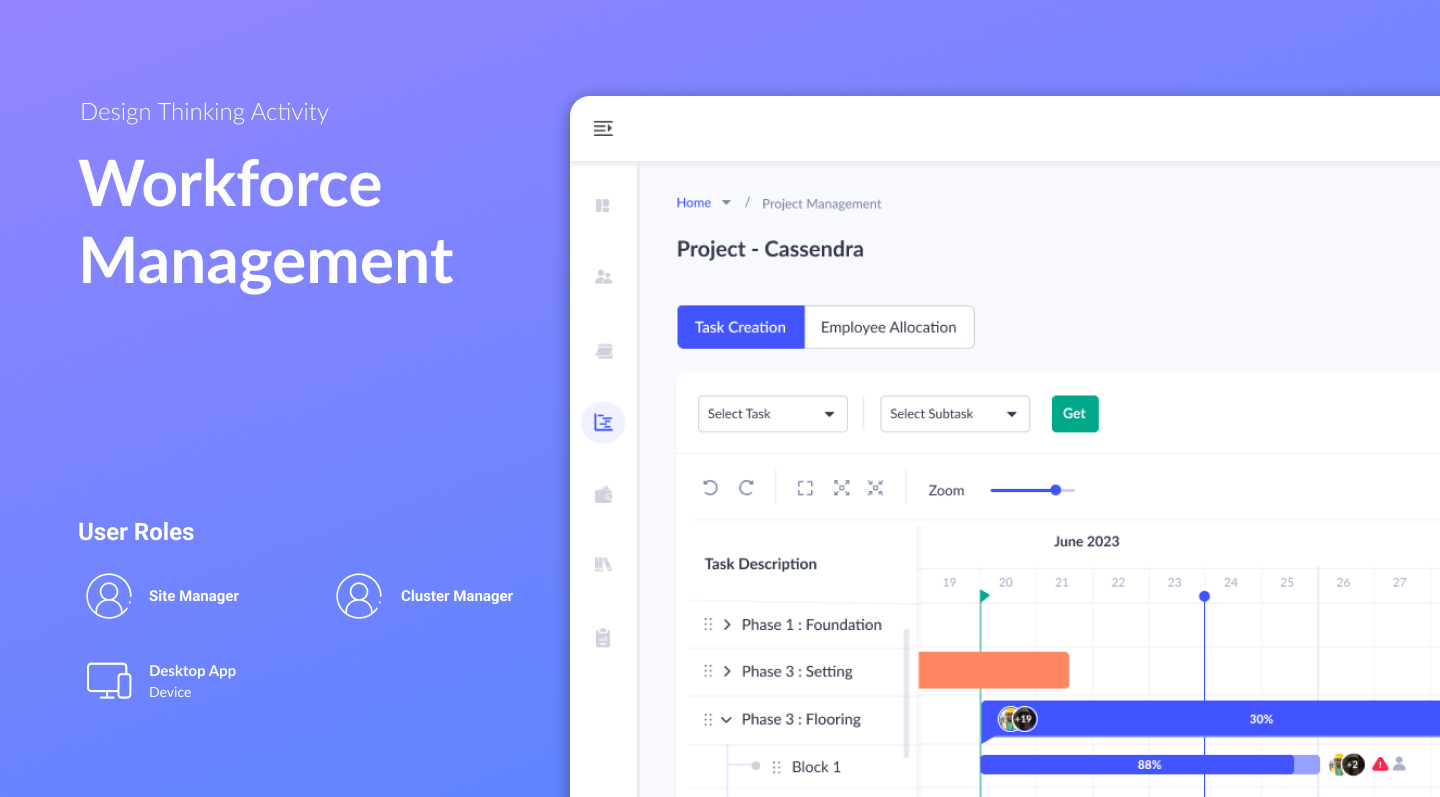
ABC Construction Company needed a comprehensive solution to monitor, assign tasks, and manage payments for 2,000 blue-collar employees spread across 10 different construction sites — handling both daily and weekly payment cycles while ensuring accuracy and efficiency. This design thinking project involved defining user roles, mapping pain points, building personas and HMW statements, structuring the information architecture, and delivering final UI designs for the Site Manager — the primary user managing day-to-day operations on the ground.
 1 / 6
1 / 62,000 Workers. 10 Sites. No Unified System.
ABC Construction Company manages 2,000 blue-collar employees spread across 10 different construction sites. Task assignments were handled manually, attendance was tracked on paper, and payment distribution — both daily and weekly — was slow and prone to errors. The company needed a single system to bring task tracking, attendance, and payments together across both management tiers: the Cluster Manager overseeing all sites from headquarters, and the Site Manager running operations on the ground.
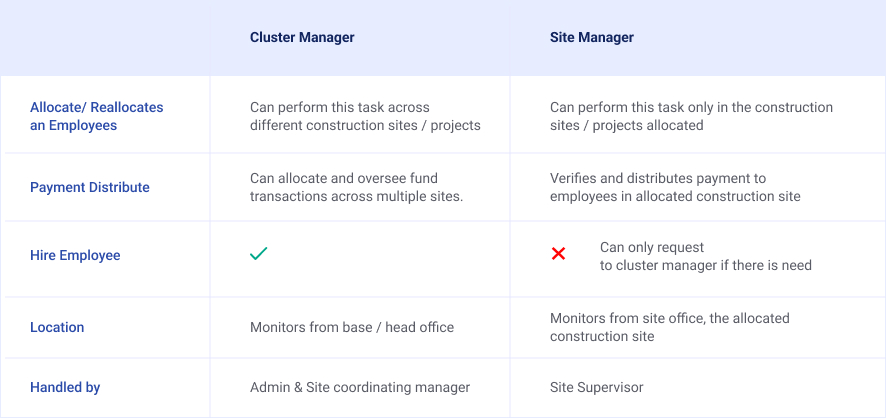
Two Roles. Different Scopes. One Platform.
The Cluster Manager operates from the base or head office — managing work across all 10 construction sites, overseeing fund transactions, hiring employees with required skills, and allocating workers to sites. The Site Manager operates from within their assigned site — monitoring progress, assigning tasks, verifying and distributing payments, and reporting to the Cluster Manager. The two roles share a platform but with clearly scoped permissions: the Cluster Manager sees across all sites; the Site Manager acts only within theirs.
Manual Processes at Every Critical Step
Three operational problems drove the project. First, assigning tasks to workers was inefficient — no visibility into real-time availability or skill matching meant manual coordination and misallocation. Second, attendance and work hours were tracked on paper, creating gaps, errors, and delays in payroll calculation. Third, payment distribution was slow and error-prone — manual processes introduced mistakes, and there was no digital record trail for vouchers or wage calculations.
- Task assignment: no real-time availability or skill data — purely manual coordination
- Attendance: paper-based tracking led to errors in timesheet calculation and wage computation
- Payments: manual distribution process prone to delays, errors, and missing voucher records
Five How Might We Statements Shaped Every Feature
A persona was built for the Site Manager — the primary daily user — capturing their goals, pain points, and operational context. From this, five Point of View and How Might We statements were developed: How might we simplify attendance and leave tracking? How might we improve project management efficiency? How might we simplify employee allocation under low workforce availability? How might we surface immediate action items without constant context switching? And how might we help managers plan around unpredictable weather?

Each HMW Mapped Directly to a Feature
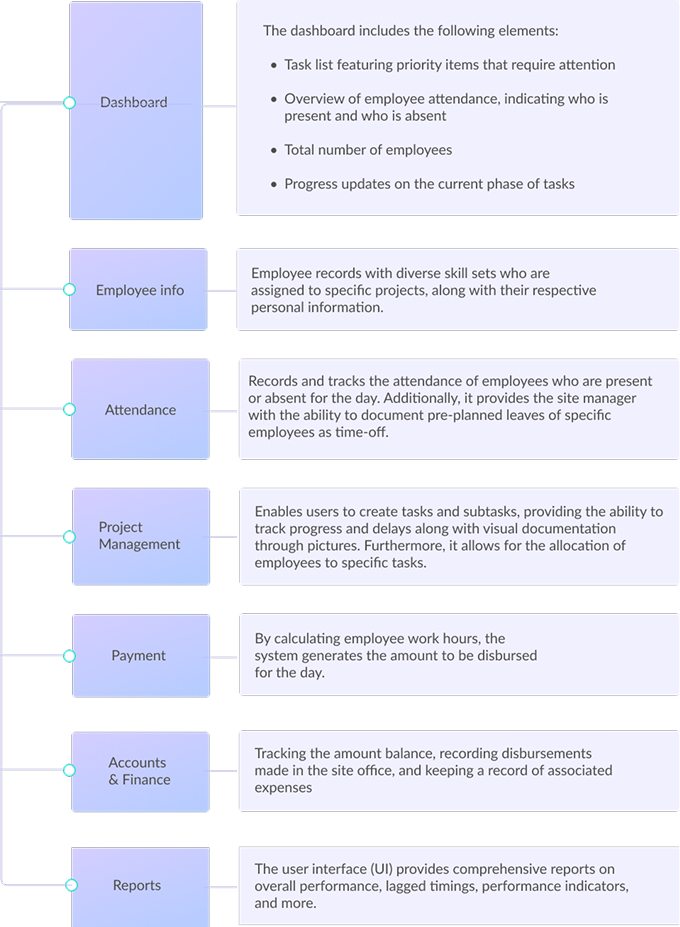
The information architecture was structured so that every HMW statement translated into a specific feature: a Gantt chart for project and task management efficiency, an employee scheduler for allocation under limited workforce availability, biometric-integrated attendance with a time-off feature for leave planning, a to-do feed aggregating immediate action items, and weather notifications with a provision to log delays. Nothing was designed without a corresponding HMW anchor.
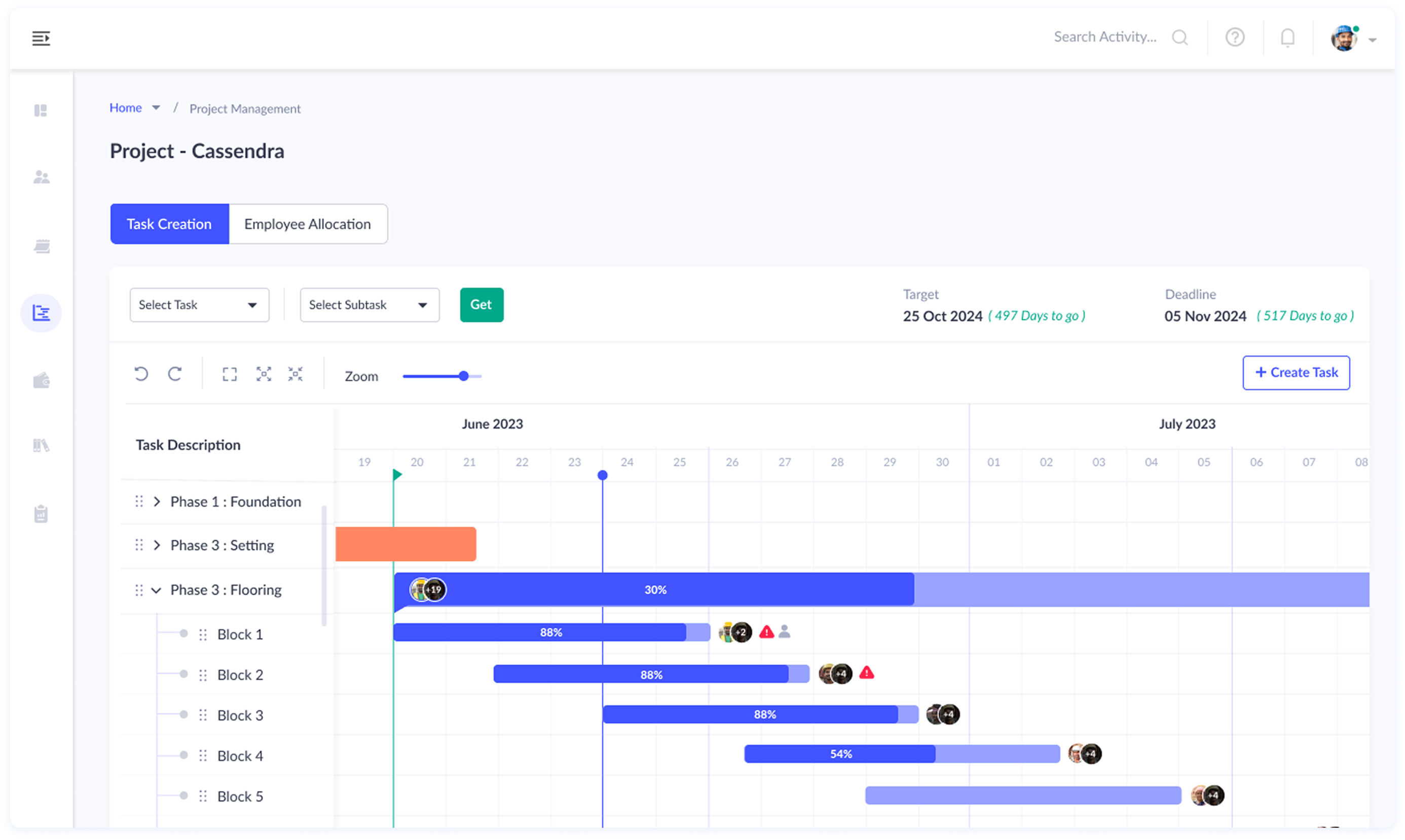
Gantt Chart — Project Progress Without the Spreadsheet
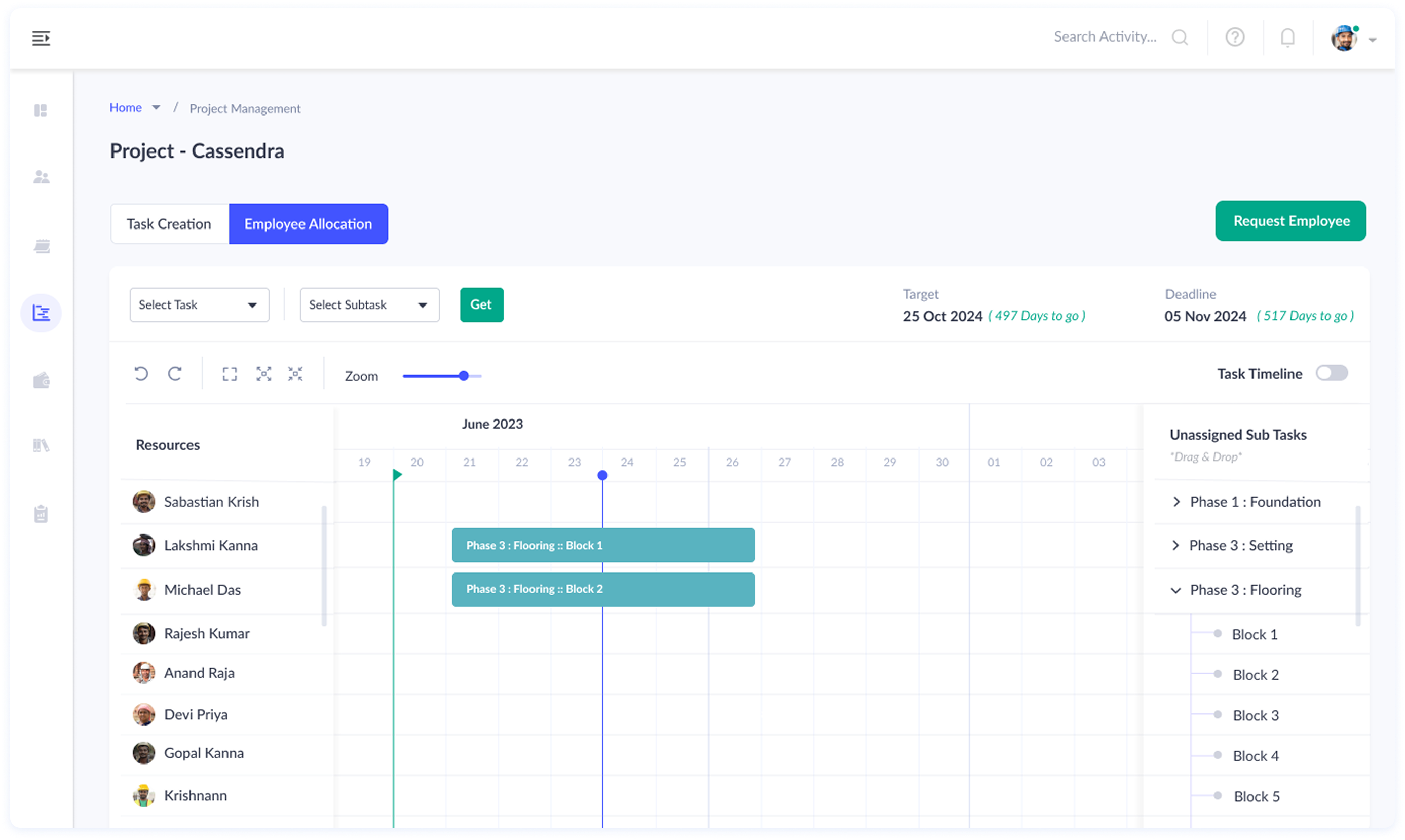
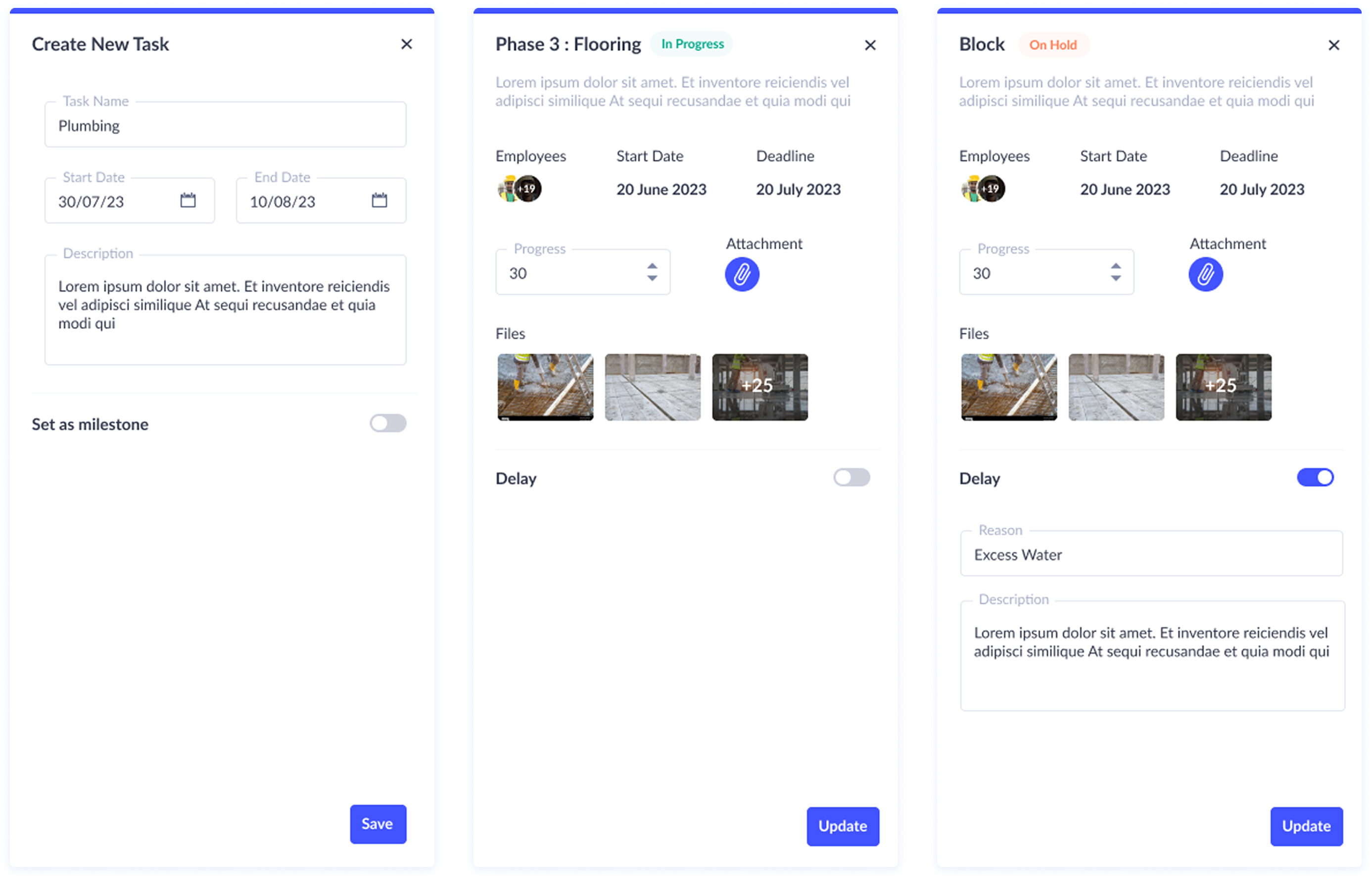
The Gantt chart view gives the Site Manager a timeline-based view of all tasks within the construction project — with the ability to create new tasks, assign employees, set durations, and monitor progress. This directly addresses the HMW around project management efficiency: the manager can see what's on track, what's delayed, and where resource gaps are forming — without having to manage multiple spreadsheets or manually consolidate status from different sources.
Employee Scheduler — Allocation Under Low Availability
The scheduler allows the Site Manager to assign employees to tasks based on availability and skill — particularly useful on days when workforce availability is limited. The view shows who is available, who is already assigned, and where there are gaps — making allocation decisions faster and more informed. This directly addresses the HMW around employee allocation: the scheduler aids in assigning employees to new tasks and effectively reallocating them when specific days have limited workforce.
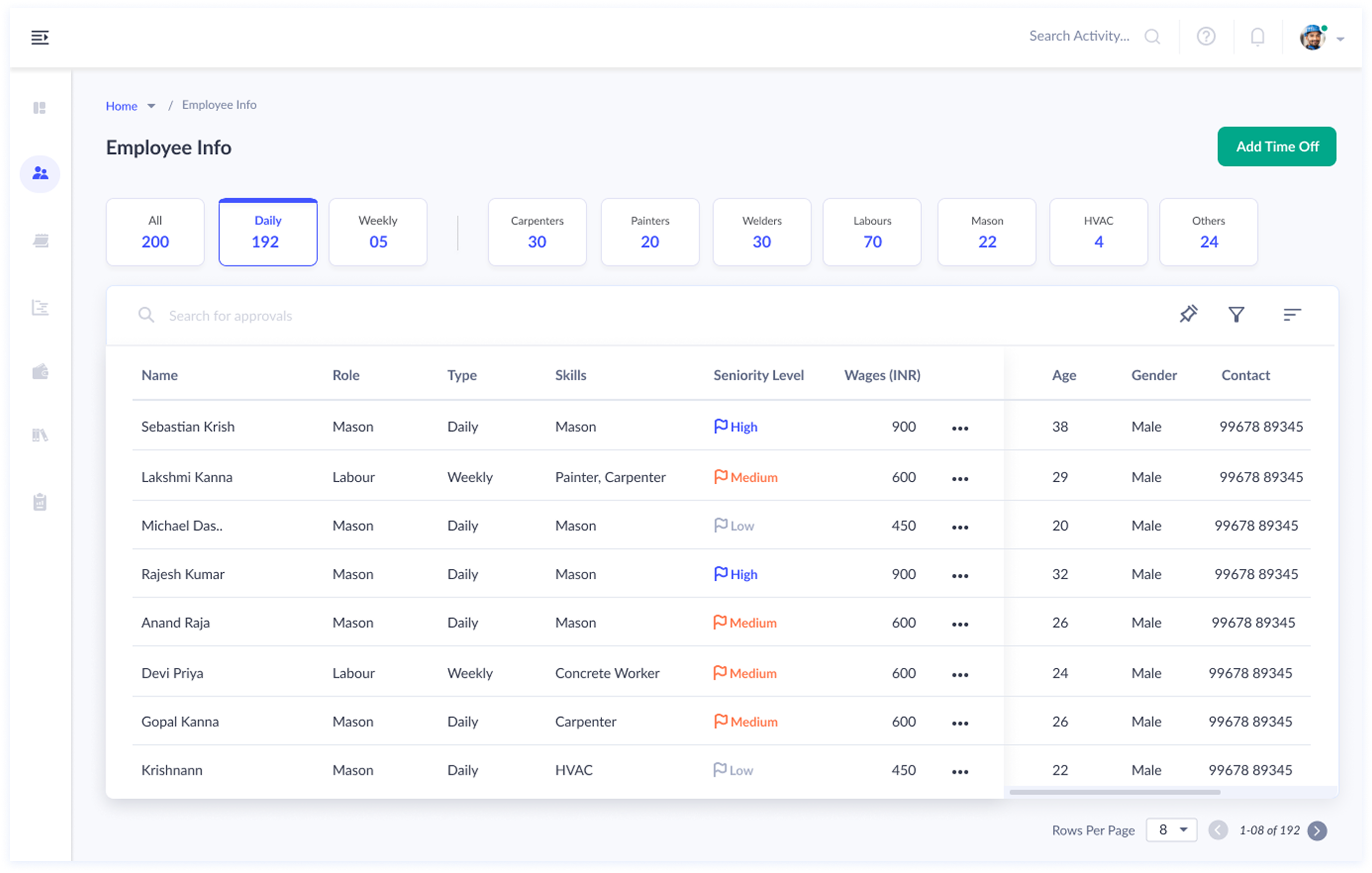
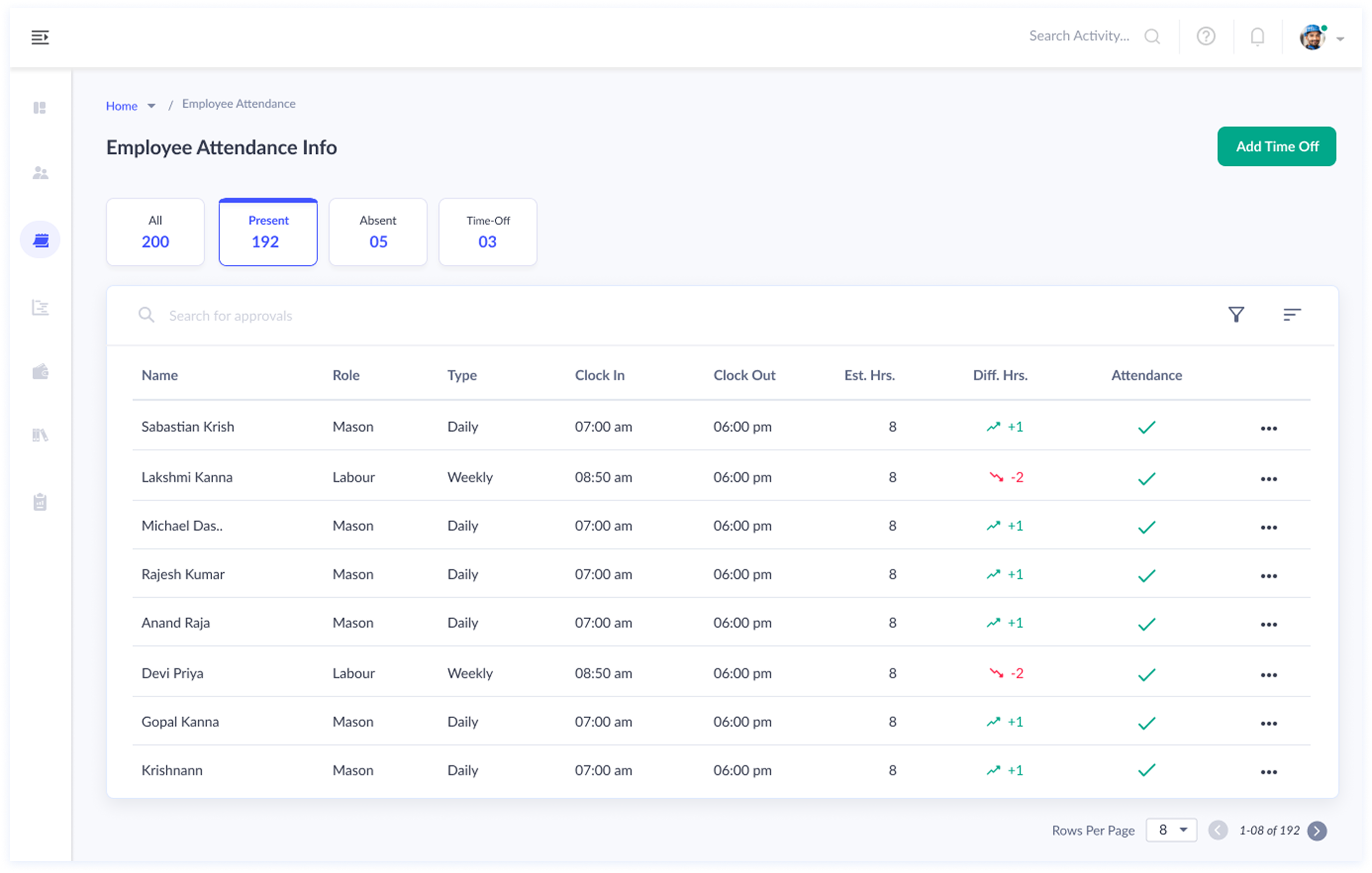
Attendance, Leave, and Employee Records in One View
The employee management section consolidates attendance records (fed from biometric clock-ins), planned leave requests, and individual employee information in a single view. The Site Manager can see who is present, who has taken planned leave, and who is absent — and the data feeds directly into wage calculation for the daily and weekly payment cycles.
Payment Distribution with Biometric Authentication
The payment management screens handle wage distribution for both daily and weekly payment cycles. Employee wages are calculated based on hours worked (from biometric records), skill level, and seniority. The Site Manager oversees distribution, and vouchers are generated and stored digitally for each transaction — replacing the manual paper-based process and creating a traceable record.
To-Do Feed, Weather Alerts, and Site Overview
The dashboard brings together the most immediate operational signals: a to-do feed aggregating action items that need attention across tasks and assignments, next-day weather predictions to help plan accordingly, a provision to log weather-related task delays, and an overview of current site status. This addresses the context-switching problem: the Site Manager no longer needs to navigate across multiple screens to find what needs action right now.
Every Pain Point Addressed by a Dedicated Feature
The final design directly resolves each of the three core pain points identified at the outset. Task assignment is now informed by real-time scheduler data. Attendance is captured biometrically and surfaced in the same view as leave records. Payment distribution is digitised with voucher generation and a traceable record for every transaction. The to-do feed and weather module address the operational realities of construction site management that are often left out of enterprise software.
- Task assignment informed by real-time employee availability and skill data via the scheduler
- Attendance tracked biometrically — no paper, no manual entry, direct feed into payroll calculation
- Payment distribution digitised with automated voucher generation and audit trail
- To-do feed eliminates constant context switching across screens for urgent action items
- Weather logging acknowledges construction realities — delays can now be recorded and tracked
Ask About This Project
Ask about this project