AI Driven Products
Contextual Search
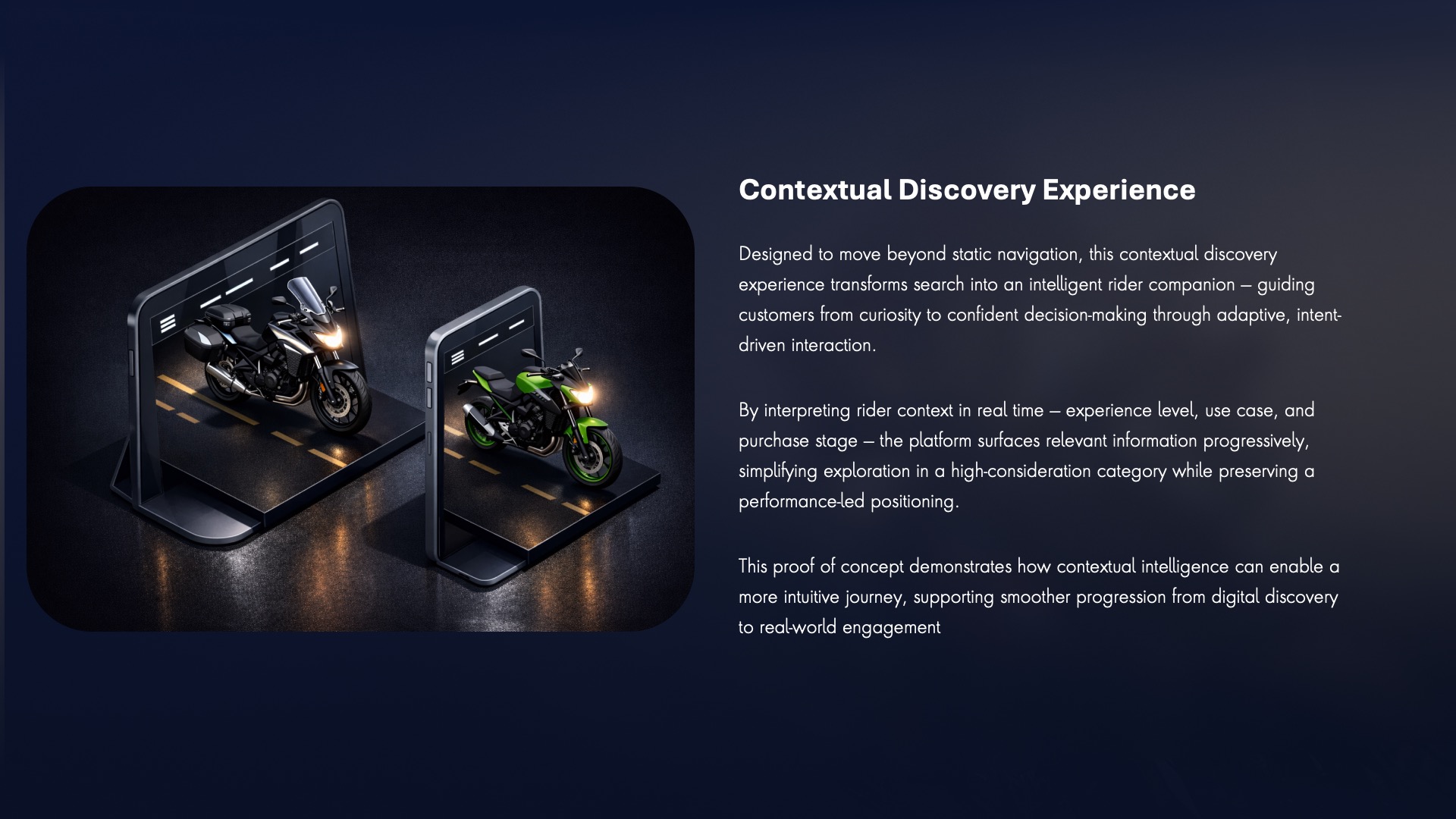
A global multi-segment two-wheeler brand approached us to rethink how riders discover products online. The existing platform had traditional search, a rule-based chatbot, comparison tools, pricing visibility, a dealer locator, and test ride booking. Everything functioned. But nothing understood the rider. We proposed replacing conventional search with an intent-driven contextual exploration layer — transforming search into a guided advisory experience.
 1 / 4
1 / 4The Platform That Worked But Didn't Understand
A global multi-segment two-wheeler brand had a fully functional digital platform — traditional search, rule-based chatbot, comparison tools, pricing visibility, dealer locator, and test ride booking. Everything worked. But when a rider searched 'comfortable for long rides with pillion', they got filtered product grids and predefined chatbot replies. The system recognized keywords. It did not interpret aspiration, lifestyle, or intent.
Specification-Led Discovery in an Intent-Driven World
Motorcycle discovery was entirely specification-led. The experience lacked emotional intelligence — it could not distinguish between a rider seeking weekend freedom and one optimizing for urban commuting. Both queries might use the same words, but they represent entirely different riders, needs, and decisions.
- Users searching by lifestyle intent received specification-filtered results
- The chatbot responded to keywords, not aspiration or context
- No connection between discovery and conversion — tools were siloed
Instead of Improving the Chatbot, We Removed It
The insight was architectural: the problem wasn't the chatbot's quality — it was the chatbot's category. A rule-based overlay on a specification search cannot produce advisory behavior. The solution required replacing the search paradigm entirely, not patching it. We proposed a Contextual Search Layer — a dedicated conversational interface that interprets rider intent, asks adaptive follow-up questions, and recommends vehicles based on lifestyle signals.
Intent Detection, Guided Pathways, and Full-Funnel Integration
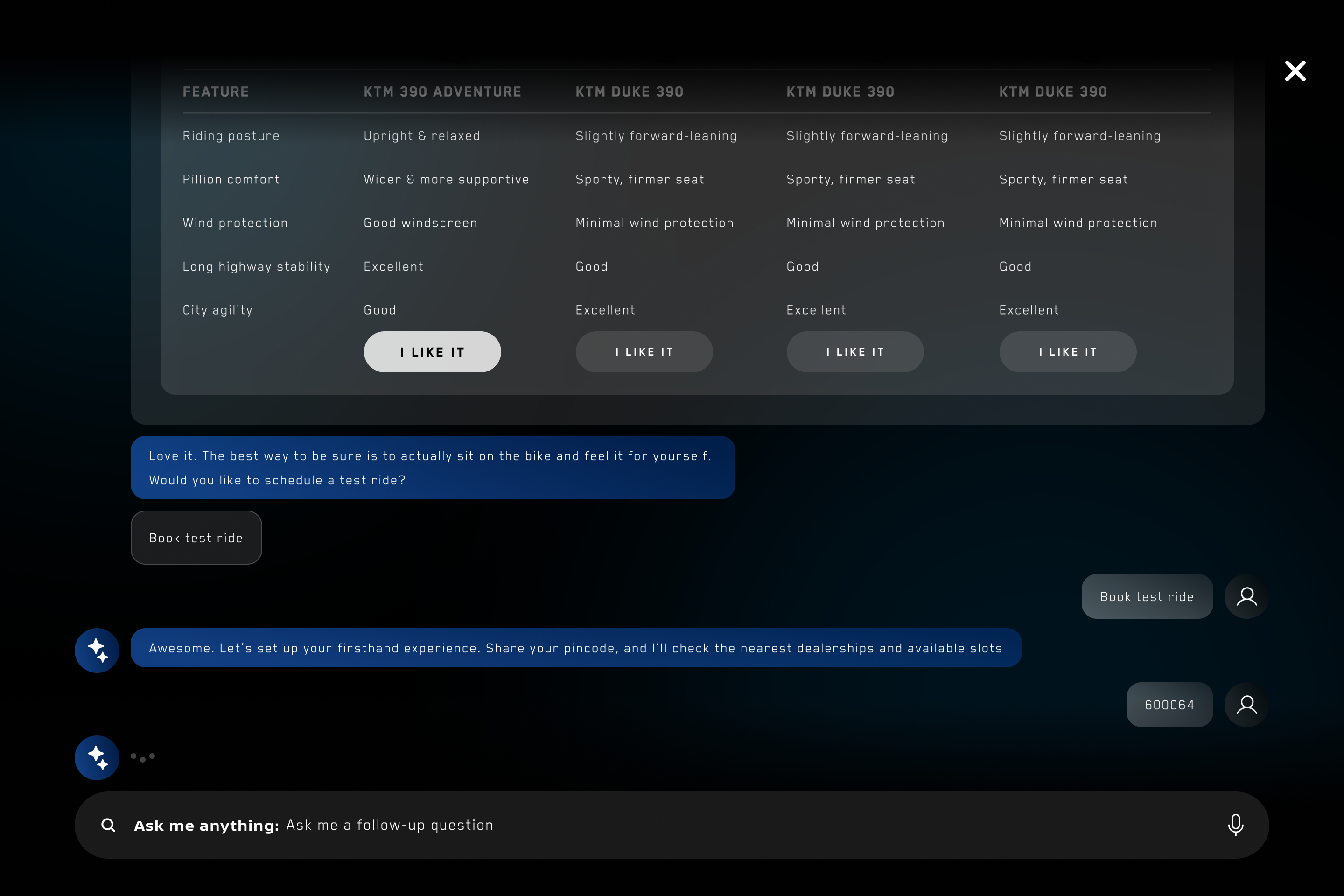
The intelligence layer detects ride purpose, terrain preference, solo vs. pillion use, comfort vs. performance bias, and frequency of use. Instead of showing products immediately, it offers curated lifestyle directions — Urban Agile, Weekend Explorer, Touring Comfort, Performance-Focused — that dynamically narrow into vehicle recommendations. Unlike traditional bots, the system was deeply integrated with comparison, pricing, dealer discovery, test ride booking, and service scheduling.
One Continuous Conversational Interface — No Friction Breaks
A user typing 'Can I test ride this near me?' would trigger location detection, nearest dealer suggestion, available slot display, and booking confirmation — all within the same conversational interface. No switching between tools. No friction breaks. The interaction was designed to feel human, advisory, and adaptive — not robotic, not scripted.
From Catalog Navigation to Experience-Led Commerce
For users: reduced cognitive overload, higher decision confidence, emotionally aligned recommendations. For the business: increased engagement depth, higher probability of test ride booking, structured rider-intent data capture, and clear digital differentiation. The concept moved the brand from functional utility to intelligent advisor.
- Reduced cognitive overload through lifestyle-driven pathway navigation
- Higher test ride booking probability through frictionless funnel integration
- Structured rider-intent data capture as a strategic asset
AI Layered Meaningfully Creates Understanding, Not Just Automation
This project demonstrated that AI's role in experience design is not to automate transactions but to create contextual understanding. When search interprets intent — not just keywords — it becomes an advisor. The shift from catalog navigation to experience-led commerce is a strategic repositioning, not a feature update.
- Lifestyle signals are richer discovery inputs than product specifications
- Advisory tone must be built into interaction architecture, not added through copy
- Full-funnel integration within a single conversational flow eliminates conversion drop-off
Ask About This Project
Ask about this project